
Old Mission Dam: The 200-year-old engineering marvel hidden in Mission Gorge


Located in the rugged landscape of Mission Trails Regional Park is a stone structure that quietly tells one of San Diego’s earliest stories.
More than 200 years ago, an ambitious engineering project was built along the San Diego River to capture water, support agriculture, and help sustain Mission San Diego de Alcalá.
Today, Old Mission Dam remains one of the region’s most important reminders of the challenges involved in establishing the Spanish mission community and the ingenuity used to overcome them.

Construction of the dam and irrigation system began around 1809 and was completed in 1815. The project was designed to divert water from the San Diego River to Mission San Diego de Alcalá and included a stone diversion dam, a settling basin, and a masonry aqueduct that carried water downstream to support the mission’s fields and livestock.
The stone structure was an ambitious undertaking for its time — and much of it still stands today.
A river that shaped San Diego
For thousands of years, the San Diego River corridor was home to the Kumeyaay people, who relied on the landscape for water, food, and natural resources. The river shaped where people lived and traveled through the region.


When Spanish missionaries established Mission San Diego de Alcalá in 1769, securing a dependable water supply became essential. The mission needed irrigation to grow crops and support its agricultural operations.
The answer was one of the most ambitious engineering projects undertaken in early San Diego.
Building a water system in the early 1800s
Construction of the dam and aqueduct was carried out largely by Kumeyaay laborers under the direction of Franciscan missionaries. Workers shaped stone, carved channels through the rugged terrain, and built a system capable of carrying water nearly three miles from the river to the mission.


The completed irrigation system helped transform Mission San Diego de Alcalá into a more productive agricultural center, providing a dependable supply of water for crops, orchards,s and livestock.
The changing landscape of Mission Gorge
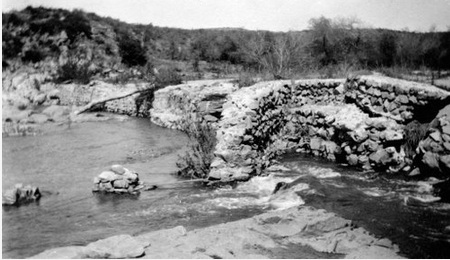
Mission Gorge continued to play an important role long after the mission era.
The surrounding landscape supported ranching, farming, and later the granite industry. Beginning in the 1870s, granite quarried from Mission Gorge was used in roads, buildings, and portions of the San Diego Bay breakwater, helping shape San Diego’s growing infrastructure.
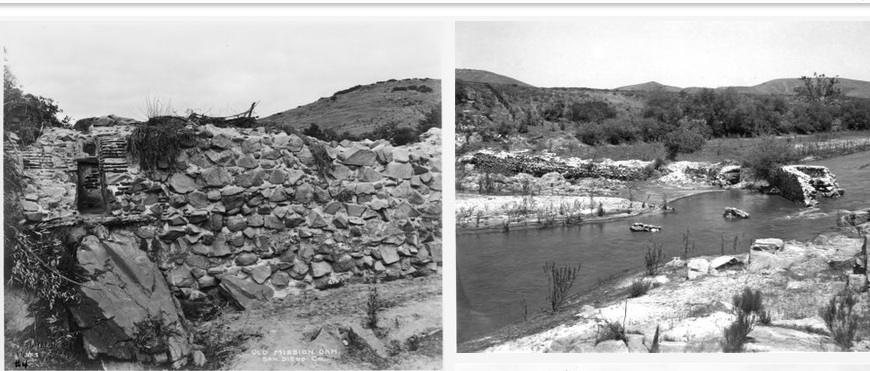
The same landscape that once supplied water for the mission later helped provide materials that helped build the growing city.
The stone structure was an ambitious undertaking for its time — and much of it still stands.
A landmark that survived time
The original irrigation system eventually fell out of use, but Old Mission Dam endured.
Floods, changing water systems and decades of development transformed the surrounding landscape, yet the stone structure remained as a physical connection to San Diego’s earliest years.

In 1963, Old Mission Dam was designated California Historical Landmark No. 52, recognizing its importance as one of California’s early engineering achievements.
Today, the dam is part of Mission Trails Regional Park, where visitors can walk across the historic structure and explore the landscape that shaped its creation.
The story still flows through Mission Gorge
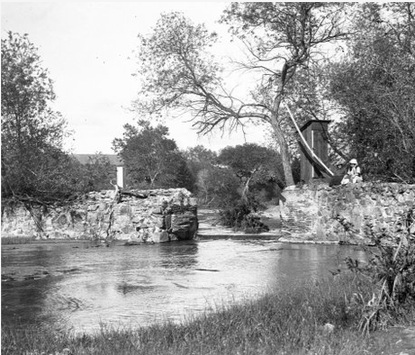
Mission Gorge has changed dramatically over the centuries. Roads, neighborhoods, and modern development now surround a landscape that once looked completely different.
Yet Old Mission Dam remains.

More than two centuries after its construction, it still stands as one of California’s oldest surviving examples of Spanish colonial engineering.
Hidden among the trails and riverbed of Mission Trails Regional Park, visitors can still walk across the same stone structure that once diverted water to Mission San Diego de Alcalá — a remarkable reminder of the ingenuity, determination, and labor of the Kumeyaay, under the direction of Franciscan missionaries, that helped shape the earliest days of San Diego.
Read more history stories here.
Sources:
National Park Service — Mission Trails Regional Park
California Office of Historic Preservation — Old Mission Dam, California Historical Landmark No. 52
City of San Diego — Mission Trails Regional Park
San Diego History Center collections
Mission Trails Regional Park Foundation
Categories
Recent Posts









GET MORE INFORMATION
