
When Ocean Beach danced: The sounds of yesteryear on the sand


Back in the day, the sounds in Ocean Beach carried a little differently.
You might have been walking near the shoreline and heard it before you saw it — music drifting from wooden pavilions set directly on the sand, where people gathered to dance within sight and sound of the Pacific.
Surviving photographs from the early 20th century show more than one pavilion-style structure associated with beachfront recreation in the Ocean Beach area, including buildings identified as dancing pavilions and bathhouse facilities positioned near the shoreline.
These were not informal gatherings on open sand. They were designated structures built for recreation and public leisure at a time that Ocean Beach was emerging as one of San Diego’s growing coastal destinations.
Historical planning references and community records suggest the “New Ocean Beach Dancing Pavilion and Bath House” stood near the foot of Newport Avenue during the late 1910s. In addition to the primary pavilion structure, the beachfront area included related bathhouse and recreation buildings that formed part of an organized system of coastal leisure facilities.
Over time, the main pavilion was repurposed as a skating rink before eventually disappearing as shoreline development and land use patterns changed.

At the same time, Ocean Beach itself was becoming more accessible through the expansion of San Diego’s streetcar system, which connected downtown neighborhoods to the coast. The beach increasingly functioned as a planned destination for weekend recreation and evening social activity rather than simply an isolated shoreline community.
Within that setting, the dance pavilions became focal points of public life. Music and dancing were built directly into the beachfront environment, creating gathering spaces where recreation, entertainment, and the coastal setting all converged.
Other dance pavilions
Similar beachfront entertainment and dance hall culture also developed in nearby coastal communities, such as Pacific Beach and Mission Beach, during the same period, reflecting a broader pattern of seaside leisure along San Diego’s coast.


Pavilion buildings and associated bathhouse facilities were positioned intentionally along the waterfront, helping define how visitors experienced Ocean Beach during this period.
As Ocean Beach continued to develop, entertainment activity gradually shifted inland toward Newport Avenue and the growing commercial district. By the 1920s, dance halls, skating rinks, and other gathering spaces increasingly operated closer to the town center rather than directly on the sand.
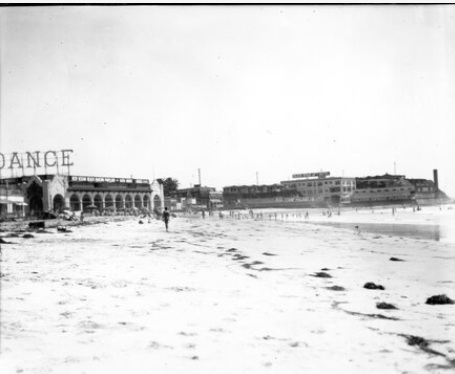
This wide, beach-level photograph captures the “New Ocean Beach Dancing Pavilion and Bath House” from the shoreline looking north, showing the prominent “DANCE” sign on the left, beachgoers on the sand, and the surf line to the right. It dates from the same 1920s era as the other photos referenced. (Photo and caption info courtesy of the San Diego History Center)
The earlier pavilion era along the shoreline slowly faded. Buildings were repurposed, removed, or lost as the coastline changed and beachfront land use evolved over the following decades.
Long gone
What remains today are bits and pieces preserved through photographs, planning records, and local historical documentation. The image of the “New Ocean Beach Dancing Pavilion and Bath House,” its sign visible against the shoreline, remains one of the clearest surviving records of a period when organized music and social life unfolded directly at the water’s edge.
Ocean Beach no longer contains those structures, but the shoreline continues to function as a gathering place shaped by many of the same rhythms of recreation and community. The dancing pavilions are gone, but for a brief period in San Diego history, music belonged directly to the sand.

Read more history stories here, and do you have a story to tell? Send an email to DebbieSklar@cox.net.
Sources:
City of San Diego, Ocean Beach Community Plan and Local Coastal Program (historic references to Ocean Beach beachfront recreation facilities, pavilion-era development, and later shoreline redevelopment patterns)
San Diego History Center photographic archives, including images labeled “Ocean Beach Dancing Pavilion” and “Dance Pavilion and Bath House,” documenting early beachfront recreation structures.
San Diego Public Library and regional historical collections documenting Ocean Beach development, including early 20th-century recreational land use near Newport Avenue.
Historical studies of San Diego streetcar expansion and coastal recreation patterns in early 20th-century Southern California.
Other various resources.
Categories
Recent Posts




GET MORE INFORMATION
