
Ramona’s marriage place: How a fictional romance helped save a San Diego landmark


Walk through Old Town San Diego, and you will quickly encounter one of the city’s most famous historic buildings: La Casa de Estudillo. For generations, visitors knew it by another name — “Ramona’s Marriage Place.”
The title sounds like a piece of local history. In reality, it is one of San Diego’s most successful examples of how literature, tourism, and preservation became intertwined.
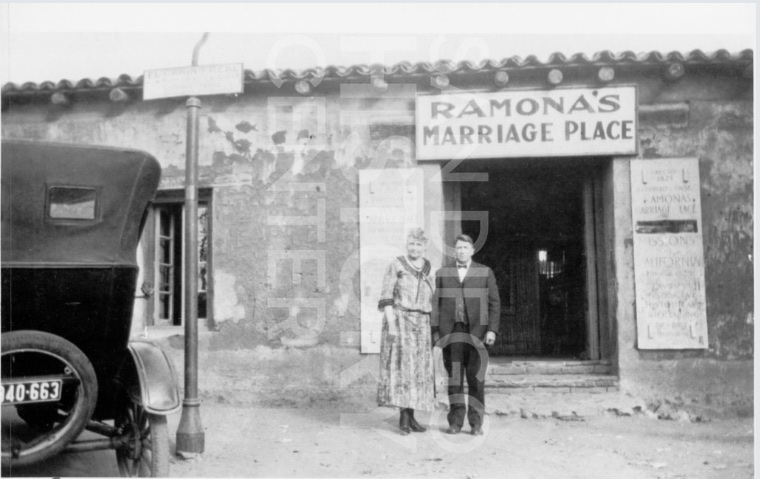
The building itself is very real. Constructed between 1827 and 1829 by José María Estudillo and his son José Antonio Estudillo, La Casa de Estudillo became one of the most important homes in early San Diego. During the Mexican period, it served as a social and community center, hosting gatherings, celebrations, meetings, and even religious activities before a permanent chapel was established nearby.
Today, it is considered one of the finest surviving examples of a large Mexican-era adobe townhouse in California.

The connection to Ramona came decades later.
The book that helped
In 1884, author Helen Hunt Jackson published Ramona, a novel set in Southern California. Although the book was fiction, it became a national bestseller and sparked widespread interest in California’s Spanish and Mexican past.
Readers traveled west hoping to see places associated with the story, even though Jackson never identified specific locations, and many of the settings were imagined or inspired by multiple places.


At the time, La Casa de Estudillo was falling into disrepair. The Estudillo family had left the property in 1887, and the adobe was deteriorating.
Around the same period, a story began circulating that the house was the location where Ramona and Alessandro were married in the novel. There is no evidence that Jackson ever visited the building, and historians have long noted that the connection was based on speculation rather than fact.
Nevertheless, the idea captured the public imagination.

A name is born
Tourists began arriving specifically to see the house. By the late 1880s, newspapers were already referring to the adobe as “Ramona’s Marriage Place.” Visitors treated it as a literary landmark, despite its fictional origins. The popularity became so intense that caretakers reportedly sold pieces of the adobe as souvenirs, accelerating the building’s decline.


Ironically, the fictional connection may have saved the structure.
To the rescue
In 1906, businessman John D. Spreckels acquired the property and financed a major restoration under architect Hazel Wood Waterman.
When the project was completed in 1910, the building reopened as a tourist attraction centered on its Ramona identity. For decades, visitors flocked to Old Town to see the famous “marriage place,” and the adobe became one of Southern California’s best-known literary tourism destinations.
The association became so strong that even the property’s National Historic Landmark application included the title “Casa Estudillo/Ramona’s Marriage Place.” Some historians have argued that without the popularity generated by Ramona, not only might the Estudillo House have disappeared, but other historic structures in Old Town might also have been lost before preservation efforts gained momentum.


When California acquired the property in 1968 as part of Old Town San Diego State Historic Park, restoration efforts shifted attention back to the Estudillo family and the building’s documented history. State historians worked to interpret the adobe as a Mexican-era residence rather than solely as a literary attraction.
Even so, the Ramona connection never completely disappeared. California State Parks notes that many people still view the building through the lens created by Jackson’s novel more than a century ago.
Still standing
Today, La Casa de Estudillo stands as a historic adobe and a reminder of how stories can shape public memory. The building was never truly Ramona’s marriage place — yet the belief that it was helped preserve one of San Diego’s most important historic structures.
Few places better illustrate the complicated relationship between fact, folklore, and preservation.
Read more history stories here, and do you have a story to tell? Send an email to DebbieSklar@cox.net.
Sources
California State Parks, La Casa de Estudillo
California State Parks, La Casa de Estudillo history and interpretation
Old Town San Diego State Historic Park, La Casa de Estudillo
National Park Service, Estudillo House
Save Our Heritage Organisation (SOHO), La Casa de Estudillo
Categories
Recent Posts







GET MORE INFORMATION
